Dreaming, thinking machines: from automata to algorithms in the markets
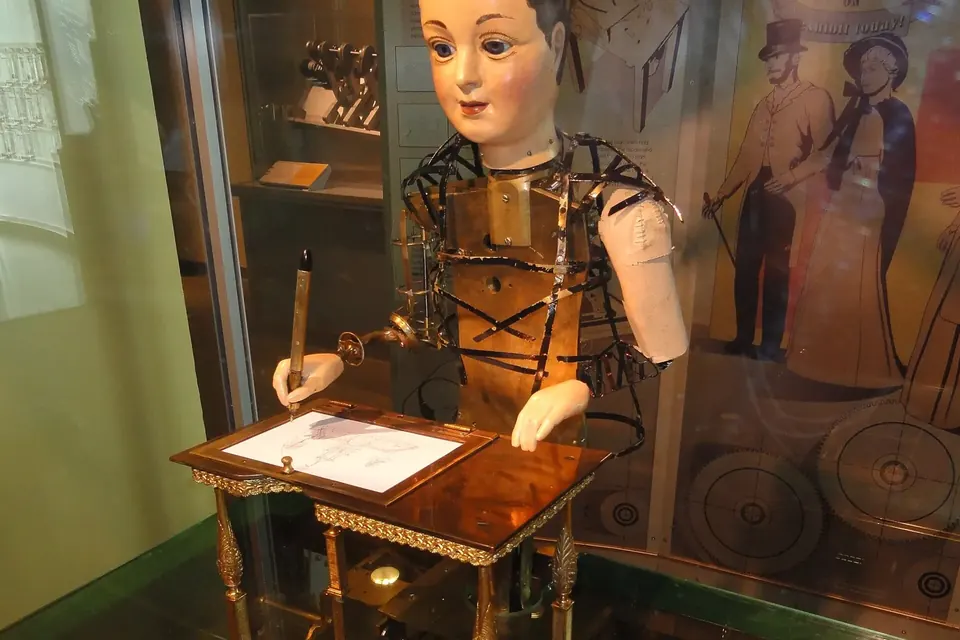
Long before computers, people built machines that seemed to think. Mechanical figures wrote letters, played music and appeared to digest food. Philosophers asked whether such machines could ever reason, and mathematicians later asked whether the question even made sense. That history is worth revisiting at a time when learning algorithms trade a large share of the world's securities, because the old debates about what machines can and cannot do still frame the arguments about them.
The age of automata
Eighteenth-century Europe was fascinated by automata. Jacques de Vaucanson exhibited a mechanical flute player and, in 1739, a "digesting duck" that appeared to eat grain and excrete it; the digestion was a trick, with the output pre-loaded. In Switzerland, the Jaquet-Droz family built a writer, a draughtsman and a musician, figures whose clockwork could be set to produce different texts or drawings. Around 1800 Henri Maillardet, a Swiss mechanician working in London, built an automaton able to produce several drawings and poems from cams stored in its body; it survives at the Franklin Institute in Philadelphia.
These machines did not think. Their behaviour was entirely stored in advance in cams and cylinders. But they posed a question that has never gone away: if a machine's outward behaviour resembles intelligence, what more is required for it to be intelligent?
Descartes' two tests
René Descartes had already answered that question in 1637. In part five of the Discourse on the Method, he argued that a machine could imitate a body perfectly, yet two tests would always reveal it. First, it could never arrange words flexibly enough to respond to the meaning of everything said in its presence. Second, though it might do some things as well as or better than people, it would fail at others, because it acted from the disposition of its organs rather than from understanding. Reason, he wrote, is a universal instrument that serves in every kind of situation, whereas a machine needs a particular arrangement for each action.
The second test is the one that still sounds modern. A system can be superhuman in one narrow task and helpless as soon as the situation changes.
Turing's imitation game
In 1950, Alan Turing published "Computing Machinery and Intelligence" in the journal Mind. He set aside the question "can machines think?" as too vague and replaced it with a game: an interrogator exchanges typed messages with a human and a machine and tries to tell which is which. If the machine is mistaken for the human often enough, the original question loses its point. Turing went through objections one by one, including the theological objection, the argument from consciousness and "Lady Lovelace's objection" that a machine can only do what it is ordered to do, and predicted that machines would play the game well within about fifty years.
ELIZA and the Chinese room
In 1966 Joseph Weizenbaum at MIT described ELIZA, a program that imitated a psychotherapist by matching keywords and reflecting statements back as questions. To Weizenbaum's dismay, some users attributed understanding and empathy to it. The lesson he drew was about people as much as machines: humans readily project intelligence onto systems that produce plausible output.
In 1980 the philosopher John Searle proposed the "Chinese room" thought experiment. A person who knows no Chinese follows a rulebook to manipulate Chinese symbols and returns answers indistinguishable from a native speaker's. Searle argued that the person, and by extension a computer running a program, manipulates syntax without understanding semantics. The argument remains disputed, but it sharpened the distinction between producing the right outputs and grasping what they mean.
For several decades, the Loebner Prize ran an annual version of Turing's test for conversational programs; chatbots such as Mitsuku won it repeatedly. The competition illustrated both progress and the limits of judging intelligence by short conversations.
Machines that "dream"
In 2015 Google researchers published images from a technique they called DeepDream, which ran a trained image-recognition network in reverse, amplifying whatever patterns it detected until clouds turned into dogs and buildings into eyes. The images were striking because they exposed what the network had learned: not concepts, but statistical regularities of its training data, which it would find everywhere if asked to.
That is a useful image for finance. A model trained on market data will find patterns, because noisy data always contain patterns. The question is whether those patterns reflect a lasting mechanism or the model's own dreaming.
What this means for markets
Machine learning has had real successes in finance, particularly where data are plentiful and the problem is stable: fraud detection, credit scoring with careful oversight, execution algorithms, document processing. Forecasting prices is a harder case, for reasons Descartes and Turing would have recognised:
- Narrow competence. A model fitted to one market regime can fail completely when conditions change, like Descartes' machine arranged for a single action.
- Adversarial environment. Unlike a chess board, a market adapts. When many participants learn the same pattern, it tends to disappear.
- Projection. As with ELIZA, people over-attribute understanding to systems that produce confident output. A backtest with an impressive curve invites the same projection.
- Accountability. Regulators increasingly require firms to explain and control the algorithms they deploy; a system no one understands is hard to supervise.
The methodological articles on this site, from a laboratory for machine learning in finance to testing meta-labelling, are in a sense practical answers to these old questions: ways of distinguishing a machine that has learned something from one that is only dreaming.
Sources
- Descartes, R. (1637). Discourse on the Method, part V. Project Gutenberg edition.
- Turing, A. (1950). Computing Machinery and Intelligence. Mind, 59(236), 433–460.
- Weizenbaum, J. (1966). ELIZA — A Computer Program for the Study of Natural Language Communication between Man and Machine. Communications of the ACM, 9(1), 36–45.
- Searle, J. (1980). Minds, Brains, and Programs. Behavioral and Brain Sciences, 3(3), 417–424.
- Mordvintsev, A., Olah, C. and Tyka, M. (2015). Inceptionism: Going Deeper into Neural Networks. Google Research blog.
- The Franklin Institute, Maillardet's Automaton.
 Momentum & factors
Momentum strategies
How momentum portfolios are built, what three decades of research found, and what erodes the paper returns.
 Systematic trading
Building a fully automated trading system
Data, signals, risk, orders and monitoring: the parts of an automated trading system and how they fail.
 Financial machine learning
A laboratory for financial machine learning
Dollar bars, triple-barrier labels, purged cross-validation and feature importance: the pipeline step by step.